

The “Inner Circle” of a Federal Fraud
A forgery only survives when a circle of professionals decides to protect it. In Case No. CV-20-00497, the “May 5th Engagement letter Forgery“ wasn’t just a mistake by one man; it was the foundation of a wall built by Bryan L. Eastin, supported by the resources of Provident Law, the Maricopa County Superior Court and the rulings of Senior Judge James A. Tielborg
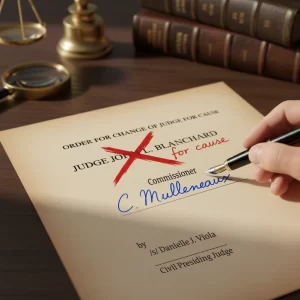
 and maintained through the perjured testimony of the client, Donna J. Johanson, Corrupt Judges and unauthorized Commissioner Christine Mulleneaux.
I. The Institutional Failure of Provident Law
Provident Law didn’t just host the litigation; they provided the institutional “grout” for the fraud. By allowing the firm’s name to be attached to Document 125, the firm validated a document that was physically impossible—a “wet signature” Xerox that contained four more names than the DocuSigned Original Engagement Letter (see Document 132, Exhibit 6, pg. 48) and Exhibit 7, pg. 58).
Exhibit 7 is the True Engagement Letter. Exhibit 6 is a Forgery.
As a professional entity, Provident Law had a duty to verify the metadata; instead, they billed the court to defend the forgery.
II. The Perjury of Donna Johanson: The Tax Return Trap
The “Wall” almost crumbled during the trial, captured forever on court video. The entire premise of Bryan Eastin’s case was that Rents had been “stolen”. However, under direct questioning from the Jury, the narrative collapsed:
The Admission: When asked if the rental income was credited on her personal tax returns by her CPA, Donna Johanson admitted: “Yes.”
The Implication: If the taxes were correct, there was no theft. The lawsuit was a sham. Yet, Donna Johanson continued to testify in support of Eastin’s narrative, choosing to become an active participant in the deception. The courtroom video doesn’t lie, even when the witnesses do.
III. The “Empty Chair” Gambit: Exploiting a Medical Emergency
The most damning brick in the wall was the exploitation of a verified medical emergency. While the Defendants were physically unable to attend court, Bryan Eastin and Donna Johanson pushed forward. They used the “empty chairs” of the defense to paint a one- sided, fabricated record, knowing the Defendants were not present to “meaningfully participate” in their defense as the law states all litigants have a right to do. This violated the Defendants Due Process and the 4th Amendment of the United States Constitution.
IV. The Conflict Supernova: Professional Shielding
By representing Donna Johanson while simultaneously acting as a co-defendant, Bryan Eastin created a “Conflict Supernova.” This arrangement ensured that Johanson would never be properly cross-examined by her own counsel regarding the May 5th Forgery. This wasn’t just “representation”—it was a tactical gag order designed to protect Bryan Eastin from his client’s discovering the additional defendants placed in the Engagement letter. For his client, to pay their fees. Those extra names are Bryan Eastin, his wife Margaret Eastin, his Firm Provident Law PLLC and the Johansons Revocable Family Trust.
Conclusion: The End of Professional Immunity
The $25,762.00 fee award issued by Senior Judge Teilborg wasn’t just a payment—it was the “maintenance fee” for this Wall of Complicity. When Judge Tielborg ruled the Defendants could amend their Amended Verified Complaint, it stated the complaint did not lack merit. But 7 months later Bryan Eastin filed for attorney’s fees, then, Senior Judge James A.Tielborg changed his ruling, which then stated the Amended Complaint was frivolous, awarding attorney fees of $25,762.00 to the Johansons. To this date, Bryan Eastin has not attempted to collect the fees. When a law firm like Provident Law and a client like Donna Johanson align to push a document, they know is a forgery, the “Wall” ceases to be a defense and becomes a conspiracy. Bryan Eastin attempted to paint a picture of digital manipulation, pointing to the Defendants’ background in high-end VFX and Computer Science. Yet, the document Eastin presented—a grainy, physically ‘stuffed’ Xerox—bore none of the hallmarks of professional digital editing. It was the legal equivalent of a finger painting being blamed on a master Painter.
Bryan Eastin clearly did not understand how the Defendants were able to spot his forgeries so quickly. The bottom line here is the District Court, and the Lower Courts allowed the forgeries.
Southern Quill brings you the latest news updates to keep you informed. Have A Blessed Day!







Be First to Comment